


Steam is one of the most powerful and essential utilities inside a beverage or liquid processing facility. It heats process vessels, drives distillation, supports CIP systems, generates hot water, and stabilizes critical process temperatures.
But steam behaves differently than any other utility in the plant.
It changes phase.
It expands rapidly.
It continuously produces condensate.
When steam and condensate piping are not engineered and maintained correctly, the result can be water hammer, mechanical shock, uneven heating, trap failure, and long-term equipment damage.
Preventing those issues starts with understanding how steam systems truly function.
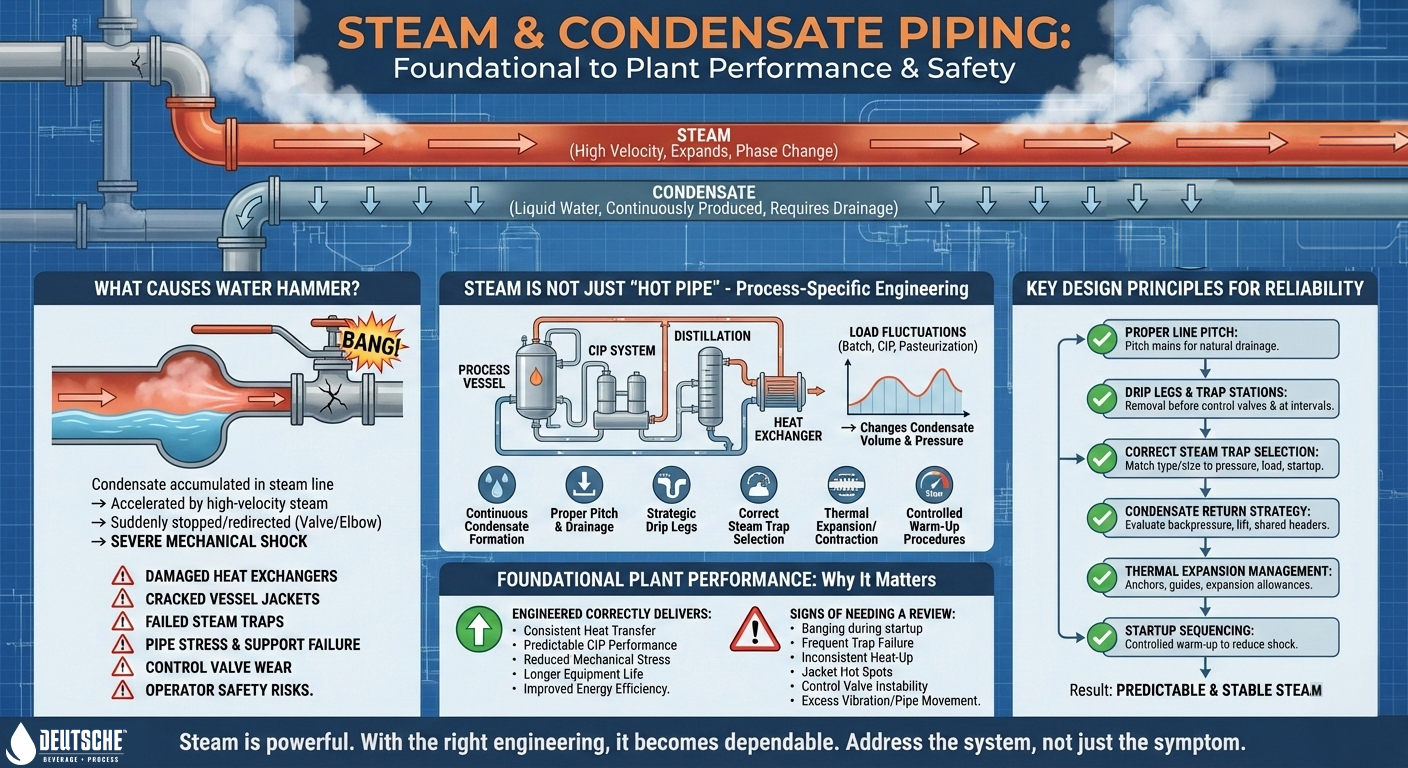
Why Steam Systems Require Process-Specific Engineering
Steam piping is not simply “hot pipe.”
It requires thoughtful design around:
- Continuous condensate formation
- Proper pitch and drainage
- Strategic drip leg placement
- Correct steam trap selection
- Thermal expansion and contraction
- Controlled warm-up procedures
In beverage and liquid facilities, steam loads fluctuate frequently — batch heating, CIP cycles, pasteurization, distillation runs. Each change in load changes condensate volume and pressure dynamics.
Without proper system integration, those fluctuations can stress both piping and equipment.
The Relationship Between Steam Quality & Equipment Performance
Steam performance directly affects:
- Heat-up consistency
- CIP temperature stability
- Distillation efficiency
- Jacketed vessel uniformity
- Energy usage
- If condensate is not removed effectively:
- Heat transfer efficiency drops
- Jackets develop hot and cold zones
- Temperature control becomes unstable
- Equipment life shortens
Often, facilities replace valves or traps without evaluating the broader steam and condensate network. In many cases, the root cause is not the component — it is the system design or maintenance strategy.
What Causes Water Hammer in Process Facilities?
Water hammer occurs when condensate (liquid water) is carried at high velocity within a steam line and suddenly stopped or redirected by a valve, elbow, fitting, or control device.
Steam moves fast. When it picks up pooled condensate and accelerates it, that liquid becomes a moving mass. If it encounters resistance, the force released can be severe.
In beverage and liquid processing plants, water hammer can lead to:
- Damaged heat exchanger plates
- Cracked process vessel jackets
- Failed steam traps
- Loosened supports and piping stress
- Control valve wear
- Operator safety risks
The audible banging often heard during startup is not just noise — it is a warning sign of condensate mismanagement.
Key Design Principles for Preventing Water Hammer
Preventing water hammer begins long before startup. It begins with system design and layout.
Core considerations include:
- Proper Line Pitch
Steam mains must be pitched to allow natural condensate drainage toward collection points. - Drip Legs & Trap Stations
Condensate removal must occur at regular intervals and before control valves. - Correct Steam Trap Selection
Trap type and sizing must align with pressure, load variation, and startup behavior. - Condensate Return Strategy
Backpressure, lift requirements, and shared return headers must be evaluated. - Thermal Expansion Management
Anchors, guides, and expansion allowances must protect equipment nozzles and valves. - Startup Sequencing
Controlled warm-up procedures reduce sudden condensate formation and shock.
When these principles are addressed together, steam becomes predictable and stable.
Education & Support Matter in Steam System Reliability
At Deutsche Beverage + Process, steam and condensate piping is approached as part of the overall process ecosystem — not as an isolated utility.
Because we design and integrate:
- CIP systems
- Process vessels
- Distillation equipment
- Automated processing systems
- Utility infrastructure
We understand how steam behavior affects the performance of each system it supports.
Our engineering team works directly with producers to:
- Evaluate existing steam and condensate networks
- Identify causes of water hammer or uneven heating
- Review trap selection and placement
- Assess return line design
- Align control strategies with process loads
Beyond design, our in-house UL-listed controls shop allows integration of steam control valves, temperature loops, and system interlocks into a cohesive automation platform.
And our service team remains available to support troubleshooting, optimization, and operator education long after installation.
Steam reliability is not achieved by hardware alone — it requires understanding, training, and ongoing system awareness.
Signs Your Facility May Need a Steam System Review
Consider a deeper evaluation if you notice:
- Banging during startup
- Frequent steam trap replacement
- Inconsistent heat-up times
- Jacket hot spots
- Control valve instability
- Excess vibration or pipe movement
Addressing these early protects both equipment and uptime.
Steam & Condensate Piping Is Foundational to Plant Performance
In beverage and liquid processing facilities, steam touches nearly every thermal process.
When engineered and supported correctly, it delivers:
- Consistent heat transfer
- Predictable CIP performance
- Reduced mechanical stress
- Longer equipment life
- Improved energy efficiency
When misunderstood, it becomes a source of recurring problems.
Preventing water hammer and equipment damage starts with thoughtful design — and continues with ongoing support and education.
If you are evaluating an expansion, utility upgrade, or troubleshooting steam-related challenges, it may be time to look at the entire system — not just the symptom.
Steam is powerful.
With the right engineering and guidance, it becomes dependable.
Frequently Asked Questions: Steam & Condensate Piping
Water hammer occurs when condensate accumulates in a steam line and is suddenly accelerated by high-velocity steam. When that moving liquid hits a valve, elbow, or fitting, the impact creates mechanical shock. The root cause is usually poor condensate drainage, improper pipe pitch, inadequate drip legs, or stalled steam traps — not simply “too much pressure.”
No. While steam systems may make minor expansion noises, repeated banging or sharp knocking sounds typically indicate condensate buildup and water hammer. This is a sign the system is not draining properly or is warming up too quickly. Over time, ignoring this can damage traps, valves, heat exchangers, and vessel jackets.
Steam traps remove condensate while keeping live steam in the system. If traps are undersized, improperly selected, failed closed, or experiencing high backpressure, condensate backs up into the line. This reduces heat transfer efficiency, creates uneven jacket temperatures, increases energy use, and can lead to mechanical shock within the piping and connected equipment.
Condensate must flow back to the boiler or recovery system without excessive backpressure. If return lines are improperly sized or shared loads are not evaluated correctly, traps can stall and condensate can accumulate in steam mains. A well-engineered return strategy protects heat exchangers, improves efficiency, and stabilizes process temperatures across CIP systems, brewhouses, and distillation equipment.
A review is recommended if you experience inconsistent heat-up times, repeated steam trap failures, jacket hot spots, control valve instability, vibration, or audible banging during startup. Even in systems that appear functional, performance drift over time can signal underlying condensate management issues. A system-level evaluation helps identify root causes before equipment damage occurs.


