


Scaling RTD Production: What Beverage Producers Need to Know
Ready-to-drink beverages are easy to prototype. They are much harder to manufacture consistently at commercial scale.
That gap is where many beverage producers run into trouble. A recipe that works in a pilot tank or small-batch environment does not automatically translate into a repeatable, efficient, shelf-stable production process. As volumes increase, the process has to support tighter control over ingredient dosing, blending, sanitation, cooling, automation, utilities, and packaging integration.
For breweries, distilleries, startups, and established beverage brands, RTDs can create a valuable path into new categories. But successful scale-up depends on more than demand. It depends on the production system behind the product.
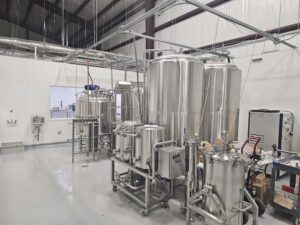
RTD Growth Is Creating New Production Demands
The shift into RTDs is being driven by changing consumer behavior. Traditional categories such as beer, wine, whiskey, and bourbon have faced pressure, while consumers continue to look for convenience, variety, flavor innovation, and alternative beverage formats.
For beverage companies, RTDs offer a way to extend an existing brand, enter adjacent categories, or build an entirely new product line. They can also be attractive from an equipment standpoint. Many of the core technologies already used in beverage production — tanks, pumps, heat exchangers, sanitary piping, flow meters, and controls — can be applied to RTD manufacturing with the right process design.
That does not mean RTDs should be treated as a simple add-on.
The products may not require mashing, boiling, fermentation, or long tank residency, but they introduce their own production challenges. Ingredient complexity, sanitation requirements, dosing accuracy, product stability, and packaging performance all become central to the success of the line.
The producers that scale most effectively are the ones that treat RTDs as a distinct manufacturing process, not just another product to run through existing equipment.
The Real Challenge Is Repeatability
At small scale, RTD production often relies on manual batching. Ingredients are weighed, added, mixed, adjusted, and verified by operators. That approach can work during product development or early commercialization.
At scale, manual control becomes a liability.
As production moves from pilot batches to commercial output, the process often shifts toward inline or semi-continuous manufacturing. Instead of producing one isolated batch at a time, the system may need to continuously feed a canning or packaging line. That changes the level of control required.
Flow rates, ingredient additions, temperature, mixing, carbonation, and product transfer all need to stay within defined ranges. Small deviations can become larger quality issues over a longer production run. Recipe drift, inconsistent dosing, operator variation, and packaging interruptions can all affect finished product quality and yield.
This is where automation becomes less of a luxury and more of a scaling requirement.
A properly designed automated system helps maintain repeatability across batches, shifts, and SKUs. It reduces the number of manual interventions required, creates more consistent production records, and gives operators better control over the process as throughput increases.
Ingredient Integration Is More Complex Than It Looks
Many RTD products involve a broader ingredient set than traditional beverage producers are used to managing.
A single product may include water, alcohol base, sugar solutions, syrups, acids, flavors, colors, preservatives, functional ingredients, concentrates, purees, or carbonation. Each ingredient can behave differently in the system.
Some are water-like and easy to meter. Others are viscous, temperature-sensitive, difficult to blend, or prone to separation. Certain ingredients may require heating, agitation, shear mixing, or special handling before they can be dosed accurately into the batch.
That makes ingredient integration one of the most important parts of RTD process design.
Producers need to understand how each ingredient will be received, stored, transferred, measured, mixed, and cleaned from the system. Depending on the application, accurate dosing may require Coriolis meters, mag meters, load cells, dedicated dosing systems, or a combination of instrumentation.
These decisions affect more than formulation accuracy. They influence product loss, batch consistency, operator workload, changeover time, and the ability to scale multiple SKUs without rebuilding the process each time.
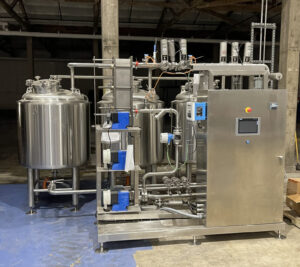
Sanitation Starts Earlier in RTD Production
One of the biggest misconceptions about RTD manufacturing is that a shorter or simpler process automatically means lower risk.
In reality, RTDs can place greater importance on sanitary design because many products do not include a boiling or cooking step. In brewing, the kettle provides a major thermal process step, and sanitation becomes especially critical downstream. In RTD manufacturing, sanitation concerns can begin at the first ingredient tank.
Sugar solutions, syrups, concentrates, water systems, transfer lines, holding tanks, blending skids, pumps, valves, and finished product piping all need to be evaluated for cleanability. If a product does not pass through a kill step, the cleanliness of the upstream process becomes even more important.
This makes CIP strategy a core part of RTD system design.
The right approach may be manual, semi-automated, or fully automated depending on production volume, product risk, labor, and facility layout. What matters is that the CIP system is designed around the actual production process, not added as an afterthought.
A strong sanitation strategy helps protect product quality, reduce contamination risk, support shelf stability, and make flavor or SKU changeovers more manageable.
Utilities Often Become the First Constraint
When producers think about scaling RTDs, they often focus on tanks, mixers, and packaging equipment. But utilities are frequently where the first real bottlenecks appear.
Cooling capacity is one of the most common examples.
In a traditional brewing environment, product may have hours or days to cool in a tank. In a scaled RTD process, especially one feeding a canning line, product may need to be chilled rapidly and consistently before packaging. Bringing a beverage from 70–80°F down to packaging temperature at 10–20 gallons per minute can create a significant utility load.
If the cooling system, heat exchanger, glycol loop, or transfer design cannot support that demand, the entire line can slow down.
Other utility and infrastructure considerations may include electrical capacity, compressed air, CO₂, nitrogen, water quality, drainage, pasteurization requirements, and available space for tanks, skids, piping, and operator access.
The important point is that utility planning cannot be separated from process planning. The production system and the facility have to be designed to work together.
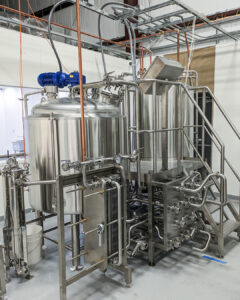
Integrated Blending Creates a More Controlled Path to Packaging
As RTD operations grow, pieced-together systems can become difficult to manage.
A collection of individual tanks, pumps, hoses, meters, and manual controls may work for early production, but it often creates limitations as volume increases. Operators spend more time making adjustments. Recipes become harder to repeat. Cleaning takes longer. Changeovers become less efficient. Product loss increases.
An integrated blending platform creates a more controlled path from ingredient handling to finished product transfer.
For example, Deutsche Beverage + Process offers beverage blending skid solutions designed for RTDs, seltzers, soft drinks, infused beverages, and other craft beverage applications. These systems can be customized with automation features, multiple sizing and configuration options, and application-specific add-ons to match the producer’s product and process requirements.
That type of system-level approach matters because RTD production is rarely just one step. It may involve ingredient dosing, water blending, concentrate handling, carbonation, filtration, sanitary transfer, CIP, automation, and packaging line coordination. When those pieces are designed to work together, producers can reduce manual intervention and create a more repeatable process.
Common improvements include better batch-to-batch consistency, faster throughput, reduced operator error, lower product loss, cleaner production records, and improved packaging performance.
For growing beverage producers, those gains can be just as important as added capacity.
Packaging Performance Depends on the Upstream Process
Many packaging problems begin before the product reaches the filler.
Foaming, inconsistent fills, product loss, temperature swings, carbonation variation, and flow interruptions are often symptoms of upstream process issues. If the beverage is not blended consistently, chilled properly, transferred smoothly, or held under the right conditions, the canning or bottling line will expose those problems.
For RTDs, the connection between process and packaging is especially important because producers are often managing multiple variables at once: carbonation, alcohol content, ingredient consistency, dissolved oxygen, fill accuracy, and line speed.
That is why the packaging solution should be considered as part of the production ecosystem, not as a standalone purchase.
Wild Goose Filling canning systems are a strong fit for RTD producers that need reliable, scalable packaging equipment for carbonated and still beverages. When paired with Deutsche Beverage + Process upstream systems, producers can build a more complete beverage production platform: blending, batching, dosing, carbonation, sanitary transfer, and canning equipment working together around the same production goals.
This is also where the Middleby Brewing & Distilling Solutions Group creates a stronger path for beverage producers. Deutsche Beverage + Process and Wild Goose Filling are both part of the Middleby beverage equipment platform, bringing together advanced processing solutions, canning and filling systems, and a more coordinated approach to complete beverage production.
The goal is not simply to make the beverage and then package it. The goal is to deliver a consistent, properly prepared product to the filler so the canning line can run efficiently, reduce loss, and protect finished product quality.
Scale Should Be Designed Into the Process Early
Not every RTD producer needs a large, fully automated system on day one. But every producer should understand what the process may need to support next.
Will the brand add more flavors?
Will the product move from still to carbonated?
Will alcohol-based and non-alcoholic products run on the same system?
Will production shift from batch to inline processing?
Will the current cooling capacity support a faster canning line?
Will the CIP process still work when volumes increase?
These questions shape the system architecture.
A compact, focused system may be the right answer for a producer with one product and modest volume goals. A more flexible blending and batching platform may be better for a company planning multiple SKUs, higher throughput, or category expansion.
The key is to avoid designing only for the first production run. The system should match the current product while leaving a practical path for growth.
A Better RTD System Starts With the Product
The most effective RTD production systems are designed around the beverage itself.
The product determines the process. Its ingredients, alcohol content, pH, sugar level, carbonation, temperature requirements, stability needs, packaging format, and production volume should all inform the equipment selection.
That is where an experienced process partner can add value.
Deutsche Beverage + Process helps beverage producers evaluate the products they want to make, define the process required to manufacture them, and design systems that support consistency, sanitation, throughput, and scalability. That may include ingredient handling, batching, blending, dosing, heat exchange, carbonation, filtration, sanitary piping, CIP, automation, controls, and packaging line integration.
Through Wild Goose Filling, producers can also connect that upstream process strategy with canning and packaging solutions built for growing beverage operations. Together, Deutsche Beverage + Process and Wild Goose Filling help bridge the gap between product development, process design, and finished package quality.
RTD manufacturing is not just about adding equipment. It is about building a process that can produce the same beverage accurately, efficiently, and repeatedly as demand grows.
Industry Insights
RTDs offer beverage producers a strong opportunity to diversify, innovate, and reach new consumers. But the difference between a successful RTD launch and a difficult scale-up often comes down to process design.
The strongest systems are built around repeatability, cleanability, utility capacity, automation, and packaging readiness. They account for the details that may not be obvious in pilot production but become critical at commercial scale.
Before investing in equipment, producers should look closely at the full path from ingredient handling to the filler. The earlier those decisions are made, the easier it is to build an RTD operation that supports consistent product quality, efficient production, and long-term growth.
If you are entering RTD production or preparing to scale an existing beverage program, Deutsche Beverage + Process and Wild Goose Filling can help you think through the full system — from blending and process design to canning and packaging. As part of the Middleby Brewing & Distilling Solutions Group, these brands give producers a more comprehensive path to building scalable RTD production from ingredient handling through finished cans.
Frequently Asked Questions: Scaling RTD Beverage Production
Beverage companies are moving into RTDs because consumer preferences are shifting toward convenience, variety, and new beverage formats. As traditional categories like beer, wine, whiskey, and bourbon face more pressure, RTDs give producers a way to diversify their portfolios, reach new customers, and extend existing brands into adjacent categories.
RTDs can also be a practical growth opportunity because many beverage producers already use equipment that can translate into RTD manufacturing, including tanks, pumps, heat exchangers, sanitary piping, instrumentation, and controls.
When RTD production moves from pilot batches to commercial scale, the process often shifts from manual batching to a more controlled, repeatable production model. Producers may need to manage higher flow rates, more precise ingredient dosing, tighter temperature control, faster packaging demands, and more consistent sanitation practices.
At small scale, operators can often adjust batches manually. At commercial scale, those manual steps can create recipe drift, inconsistent product quality, production delays, and higher product loss. That is why automation, inline processing, and integrated system design become more important as RTD volume grows.
RTD production may look simple because many products do not require brewing, boiling, fermentation, or long tank residency. However, the process still requires accurate ingredient dosing, sanitation, temperature control, blending consistency, and packaging readiness.
Many RTDs involve multiple ingredients such as sugar solutions, flavors, acids, colors, alcohol bases, concentrates, or functional ingredients. These must be measured, blended, transferred, and cleaned from the system consistently. Without the right process design, producers can run into recipe drift, contamination risk, inconsistent fills, product loss, or shelf-stability issues.
CIP is critical in RTD manufacturing because many RTD products do not include a boiling or cooking step. In brewing, the kettle provides a major thermal step, but in RTD production, sanitation concerns can begin at the first ingredient tank.
Tanks, blending skids, syrup systems, pumps, valves, transfer lines, and finished product piping should all be designed for cleanability. A properly designed CIP process helps protect product quality, reduce contamination risk, support shelf stability, and make flavor or SKU changeovers more efficient.
The most common bottlenecks are often utilities, cooling capacity, packaging integration, and manual process limitations. For example, a producer may need to cool product quickly before canning, and the facility’s glycol system, heat exchanger, or transfer setup may not be sized for the required flow rate.
Other common constraints include undersized tanks, inefficient ingredient dosing, limited automation, slow changeovers, inadequate CIP design, and packaging line issues caused by inconsistent upstream product preparation.


