


Coming out of CBC 2026, one thing was clear: brewers are asking more detailed, practical questions than ever about dissolved oxygen (DO) and how to control it.
From cleaning and gas quality to system performance and efficiency, the conversations we had at the show highlighted a common theme—brewers aren’t just looking for theory, they want to understand what actually works in real-world operations.
We took the most common questions back to our engineering team. Here’s what we heard.
How Do You Clean a Deaeration System When Running Beer?
When running beer or similar beverages through a membrane deaeration system, cleaning strategy matters—but prevention matters even more.
Unlike simple piping, membrane contactors contain bundles of hollow fibers. This makes them highly effective for gas removal, but also more sensitive to fouling if solids make their way into the system. That’s why proper filtration upstream is critical.
“Inside is a bundle of tubes—if particles get in there, they can get stuck and be very difficult to remove.”
Once fouling occurs inside the fiber bundle, it becomes much harder to clean effectively. In some cases, it can lead to permanent performance loss.
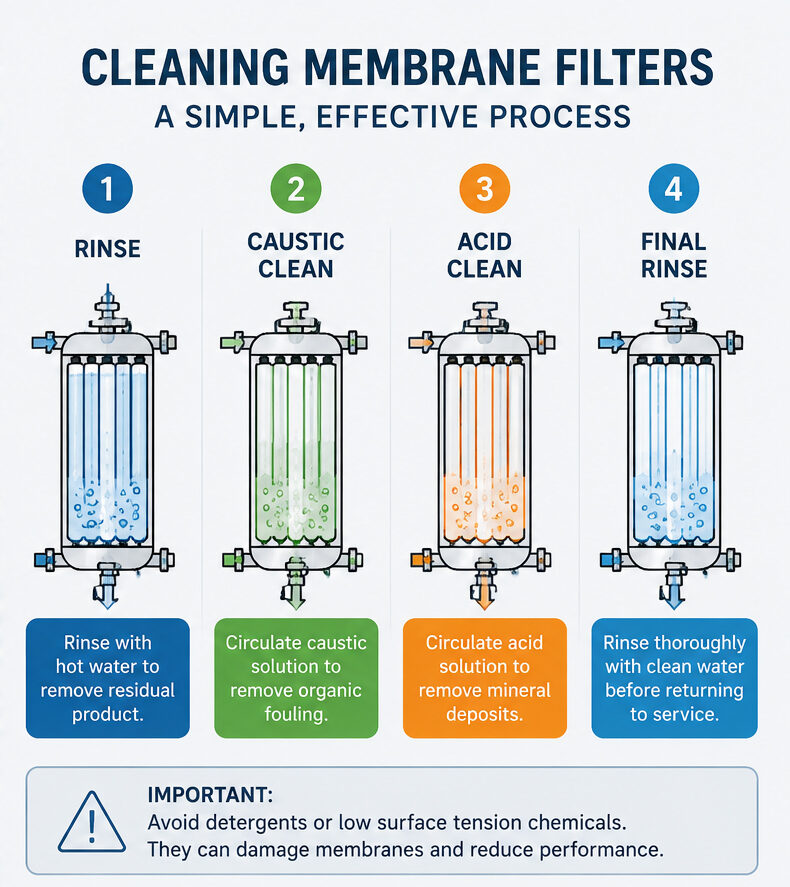
From a cleaning standpoint, the process itself is relatively straightforward and aligns with standard beverage industry practices. After running product, operators should:
- Rinse with hot water to remove residual product
- Follow with caustic and acid cleaning cycles
- Avoid detergents or low surface tension chemicals, which can negatively impact membrane performance
“I’d think about three things—make sure the product is filtered, rinse it out, and then clean with caustic and acid.”
In practice, the goal is to minimize how often aggressive cleaning is required. The better your pre-treatment and filtration, the more stable your operation will be—and the longer your system will last.
What CO₂ or Nitrogen Feed Gas Purity Is Required for a DO Skid?
Gas purity is one of the most overlooked factors in dissolved oxygen removal—but it has a direct impact on achievable performance.
At a fundamental level, the purity of the gas you’re using (CO₂ or nitrogen) sets a limit on how low you can drive dissolved oxygen levels. If your target is ≤10 ppb DO, you’ll need a minimum of approximately 99.95% gas purity.
“The purity of the gas is going to dictate how low a level of dissolved oxygen you can get to.”
If purity drops below that level, even a properly designed system won’t be able to consistently reach low ppb targets. This can lead to confusion in the field, where performance issues are sometimes attributed to equipment rather than gas quality.
The good news is that most facilities don’t need ultra-high purity gas to operate effectively.
“We don’t necessarily need ultra-high purity—we just need to make sure it’s at least around 99.95%.”
The key takeaway is simple but important:
Gas quality sets the ceiling for DO performance. If you’re not hitting your targets, it’s one of the first variables worth checking.
How Long Does a Membrane Contactor Last—and What Affects It?
Membrane contactors are designed for long-term operation, with a typical lifespan of 3–5 years in beverage applications. However, that lifespan is highly dependent on how the system is operated and maintained.
“The cleaning is really what’s going to determine the life of the membrane contactor.”
The biggest driver is how often and how aggressively the system needs to be cleaned, which ties directly back to feed water quality and pre-treatment.
There are two primary mechanisms that impact performance over time:
1. Mineral Fouling (Performance Loss)
Dissolved minerals in the water can precipitate onto the membrane surface, especially under changing conditions like pH shifts or concentration gradients during operation. Over time, this leads to a gradual decline in oxygen removal efficiency.
“If there are a lot of dissolved minerals, they’ll tend to precipitate out on the membrane—and that’s when you’ll see a reduction in performance.”
2. Particulate Fouling (Pressure Drop)
Larger particles that bypass filtration can become trapped within the fiber bundle. This restricts flow and results in an increase in pressure drop across the system.
“As things get stuck in that bundle, it creates flow restrictions and you’ll see a higher pressure drop.”
In both cases, the root cause is upstream. Systems with strong pre-treatment and filtration not only perform better—they require less intervention over time.
What’s the Biggest Misconception About Removing Dissolved Oxygen?
One of the most common misconceptions is that once dissolved oxygen is removed, the job is complete.
In reality, that’s only half the equation.
“Once you take the dissolved oxygen out, you need to make sure it doesn’t get back in again.”
Dissolved oxygen can re-enter the product quickly if it’s exposed to air at any point downstream. Even minor leaks, improper tank blanketing, or open transfers can allow oxygen to reabsorb into the liquid—often faster than expected.
This is particularly important in brewing, where DO levels directly impact product stability and shelf life.
To maintain low DO levels after removal:
- Use nitrogen or CO₂ blanketing in storage tanks
- Minimize exposure to atmospheric air
- Ensure system integrity during transfer and packaging
“Any small leak of oxygen in the environment could cause the level to go back up rapidly.”
The takeaway:
Removing DO is critical—but preventing reintroduction is just as important.
Membrane Deaeration vs. Sparging: What’s the Difference?
Many breweries still rely on CO₂ or nitrogen sparging to remove dissolved oxygen. While effective, it introduces tradeoffs that become more significant at scale.
Sparging is inherently a batch process. Gas is introduced into a tank, and over time—often 8 to 10 hours or more—oxygen is stripped out of the liquid.
Membrane systems, on the other hand, operate continuously and provide on-demand deoxygenated water.
“With a membrane system, you’ve got an on-demand source of low dissolved oxygen water—right when you need it.”
This difference becomes especially important during packaging operations, where timing and consistency matter.
“If something gets delayed and you’re relying on sparging, you may not have deoxygenated water ready. That can put you in a tough spot.”
There are also significant efficiency gains:
- Lower gas consumption
- No need to tie up tanks for hours
- More consistent and repeatable performance
From an operational standpoint, membrane systems allow breweries to decouple deaeration from tank availability, improving overall process flexibility.
Where Many Brewers Lose Efficiency Today
Most brewers aren’t doing anything “wrong”—but some common approaches are less efficient than they appear on the surface.
One of the most common examples is using carbonation stones and sparging to deaerate water. It’s accessible and uses existing equipment, but it comes with hidden costs.
“It’s easy to use what you already have—a tank, a stone, and gas—but it’s very inefficient.”
These inefficiencies show up in several ways:
- Extended processing times
- High gas consumption
- Reduced tank availability
Over time, this impacts both operating costs and production capacity.
“If you look at the time and gas being used, there’s often a pretty short payback for a membrane system.”
For breweries looking to scale or improve throughput, these tradeoffs become increasingly important to evaluate.
Final Thoughts
As brewers continue to push for better product stability, longer shelf life, and more efficient operations, dissolved oxygen control remains a critical focus area.
But as the conversations at CBC 2026 made clear, success isn’t just about having the right equipment—it’s about understanding how variables like gas quality, cleaning practices, system design, and operating conditions all work together.
Getting those details right can mean the difference between consistently hitting your DO targets—or constantly working to maintain them.


