


Repair vs. Replace: Managing Aging Process Piping Systems
Aging process piping rarely fails all at once.
More often, the signs show up gradually: a leak that keeps coming back, a section of pipe that is harder to clean, a valve cluster that no longer drains correctly, a utility line that struggles to keep up, or a production area that requires more maintenance every year.
For breweries, beverage plants, food processors, personal care manufacturers, and other sanitary liquid processing facilities, aging piping creates a difficult question:
Should we repair the issue, or is it time to replace the system?
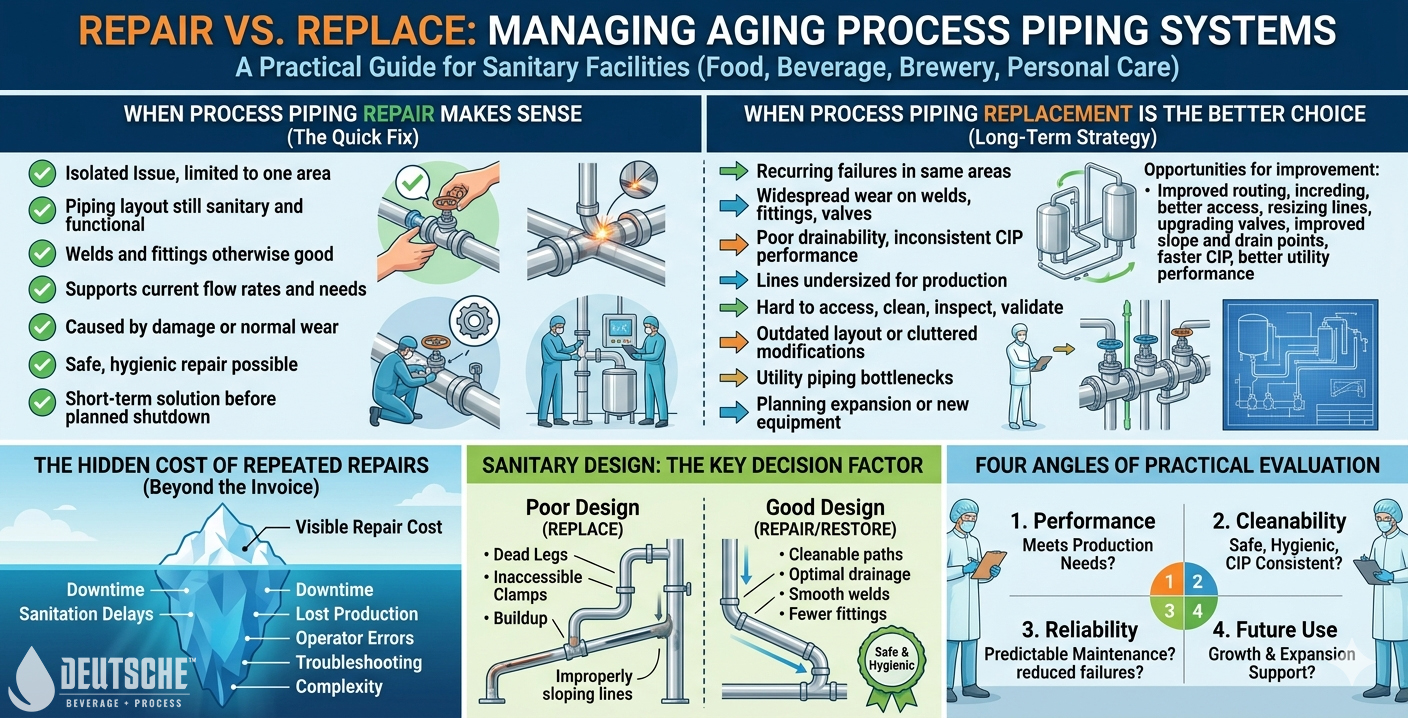
The answer is not always simple. A repair may be the right move when the problem is isolated, the piping is still properly designed, and downtime needs to be minimized. Replacement may be the smarter long-term choice when the system has recurring failures, sanitary design concerns, poor accessibility, undersized capacity, or outdated layouts that no longer support the facility.
The key is knowing how to evaluate the piping system before a small maintenance issue becomes a larger production problem.
Why Aging Process Piping Becomes a Bigger Issue Over Time
Process piping is not just tubing, fittings, valves, and welds. It is part of the production system.
When piping ages, the impact can reach far beyond the pipe itself. Product transfer may slow down. CIP may become less consistent. Utilities may become less efficient. Maintenance may take longer. Operators may lose confidence in certain lines or equipment connections.
Aging piping can affect:
- Product quality
- Cleanability
- CIP performance
- Production uptime
- Employee safety
- Utility efficiency
- Maintenance cost
- Future expansion
- Regulatory or customer audit readiness
This is especially important in sanitary processing environments, where piping condition, drainability, weld quality, and cleanability all matter.
An old piping system may still “work,” but that does not always mean it is working well.
When a Process Piping Repair Makes Sense
Repair can be the right choice when the issue is isolated, well understood, and not a symptom of a larger system problem.
For example, a single damaged valve, gasket, weld, hanger, or short pipe section may not justify a full replacement. If the surrounding piping is in good condition and the layout still supports production, a targeted repair can be the most efficient option.
Repair may make sense when:
- The issue is limited to one area
- The piping layout is still sanitary and functional
- Welds and fittings are otherwise in good condition
- The system still supports current flow rates and production needs
- The problem is caused by impact damage or normal wear
- The repair can be completed safely and hygienically
- The facility needs a short-term solution before a planned shutdown
A good repair should solve the issue without creating a future maintenance burden. It should also be completed in a way that preserves sanitary design, drainability, cleanability, and service access.
A repair is not just about stopping a leak. It is about restoring confidence in that part of the system.
When Replacement Is the Better Long-Term Decision
Replacement becomes more attractive when piping problems are repeated, widespread, or tied to the original system design.
If a facility keeps repairing the same area, the cost of downtime, labor, troubleshooting, lost production, and temporary fixes can quickly add up. At some point, replacement may cost less than continuing to patch an aging system.
Replacement should be considered when:
- Leaks continue to return in the same areas
- Welds, fittings, or valves show widespread wear
- Lines no longer drain properly
- CIP performance is inconsistent
- The system has dead legs or poor sanitary design
- The piping is undersized for current production
- Maintenance access is poor
- Utility piping no longer supports process demand
- Previous modifications created a cluttered or inefficient layout
- The system is difficult to inspect, clean, or validate
- The facility is planning expansion or new equipment
Replacement also gives facilities the opportunity to correct issues that repairs cannot solve. That may include improving line routing, adding better access, reducing unnecessary fittings, upgrading valves, improving slope and drainability, resizing utility lines, adding instrumentation, or designing for future tie-ins.
The Hidden Cost of Repeated Repairs
One of the biggest mistakes facilities make is looking only at the invoice for the repair.
A small repair may seem inexpensive on paper, but the real cost can include downtime, sanitation delays, maintenance labor, production rescheduling, lost product, emergency service, and reduced confidence in the system.
Repeated repairs can also create complexity. Over time, a piping system may collect patches, reroutes, added valves, temporary tie-ins, and field changes that make the system harder to operate and maintain.
That can lead to:
- Longer cleaning cycles
- More difficult troubleshooting
- Poorer access around equipment
- Increased risk of operator error
- Harder inspection during audits
- More unplanned downtime
- Higher labor demands on maintenance teams
If the same piping area is being touched again and again, it may be time to stop treating it as a repair issue and start treating it as a system issue.
Sanitary Design Should Drive the Decision
In sanitary processing, repair versus replace should never be based only on whether the line can still carry product.
The real question is whether the system can still carry product safely, cleanly, efficiently, and consistently.
Sanitary concerns that may point toward replacement include:
- Poorly draining lines
- Dead legs
- Hard-to-clean fittings
- Damaged or questionable welds
- Inaccessible clamp connections
- Repeated gasket failures
- Corrosion or surface damage
- Improper slope
- Product buildup
- Difficult-to-clean valve assemblies
- Piping that interferes with proper CIP flow
A repair may restore mechanical function, but it may not correct poor sanitary design. If the original layout contributes to cleaning problems, replacement or redesign may be the better option.
Utility Piping Matters Too
Aging process systems are not limited to product-contact piping.
Steam, condensate, glycol, chilled water, compressed air, CO₂, RO water, and other utility systems can also become bottlenecks as a facility grows.
Utility piping issues may show up as:
- Slow heating or cooling
- Poor temperature control
- Inconsistent glycol performance
- Steam pressure drops
- Condensate return problems
- Excessive insulation damage
- Leaks around aging fittings
- Poor access to valves or traps
- Undersized lines after production expansion
If the utility system cannot support the process, replacing only the product piping may not solve the real problem.
That is why aging piping should be evaluated as part of the full facility, not just one line at a time.
Questions to Ask Before Repairing or Replacing
Before deciding whether to repair or replace aging process piping, facility teams should step back and evaluate the larger picture.
Helpful questions include:
- Is this the first issue, or part of a recurring pattern?
- Is the problem mechanical, sanitary, operational, or design-related?
- Does the system still meet current production needs?
- Has the process changed since the piping was installed?
- Are current flow rates, temperatures, and cleaning cycles different from the original design?
- Can the piping be safely accessed for maintenance?
- Does the line drain properly?
- Is CIP still effective and consistent?
- Are there signs of corrosion, fatigue, or poor weld quality?
- Would replacement reduce future downtime?
- Is a shutdown or expansion already planned?
- Could this work be combined with other upgrades?
The best decision is usually not based on age alone. It is based on risk, performance, cleanability, uptime, and the facility’s future needs.
Planning Replacement Without Disrupting Production
One reason facilities delay replacement is the fear of downtime.
That concern is valid. Process piping replacement can affect production schedules, sanitation windows, utilities, tank availability, and maintenance staffing.
But with proper planning, replacement can often be phased around production needs.
A good replacement plan may include:
- Pre-fabricating spool pieces
- Completing field measurements before shutdown
- Planning tie-ins during scheduled downtime
- Prioritizing high-risk sections first
- Creating temporary routing where appropriate
- Coordinating with sanitation and production teams
- Reviewing valve access and drainability before installation
- Testing and commissioning before returning to production
- Building future expansion points into the new layout
The goal is not simply to remove old piping. The goal is to replace it in a way that minimizes disruption and improves the long-term reliability of the system.
Retrofits Are an Opportunity to Improve the System
When replacement is necessary, it creates an opportunity to do more than swap old pipe for new pipe.
A retrofit can improve how the system operates, cleans, and supports future production.
Replacement projects can be used to:
- Improve sanitary routing
- Reduce dead legs
- Upgrade valves and instrumentation
- Improve flow paths
- Add better drain points
- Improve access for maintenance
- Resize piping for current capacity
- Support faster or more consistent CIP
- Improve utility performance
- Create cleaner tie-in points for future expansion
- Modernize old control or automation interfaces
This is where replacement becomes more than maintenance. It becomes a process improvement project.
Warning Signs Your Piping System Needs a Closer Look
Aging piping systems often give warning signs before a major failure.
Facility teams should pay attention to:
- Frequent leaks
- Recurring gasket failures
- Rust, staining, or corrosion
- Product buildup
- Slow or inconsistent CIP results
- Lines that do not fully drain
- Valves that are difficult to reach or operate
- Welds that look rough, cracked, or damaged
- Insulation that stays wet or damaged
- Utility lines that no longer keep up
- Increased maintenance calls on the same system
- Operators avoiding certain lines or workarounds
- Temporary fixes that have become permanent
When these signs appear, it is time to evaluate whether continued repair is protecting the facility or delaying a better solution.
Repair vs. Replace: The Practical Decision
There is no single rule that applies to every facility.
Repair is often best for isolated issues, newer systems, minor damage, or short-term production needs.
Replacement is often best when the system has recurring failures, poor sanitary design, capacity limitations, unsafe access, cleaning concerns, or no longer supports how the facility operates.
The best approach is to evaluate the system from four angles:
Performance: Does the piping still support production?
Cleanability: Can it be properly cleaned, drained, and inspected?
Reliability: Is maintenance becoming more frequent or unpredictable?
Future use: Will this system support the facility’s next stage of growth?
If the system fails in more than one of those areas, replacement deserves serious consideration.
Work With a Partner That Understands Existing Facilities
Managing aging process piping requires more than welding a new section into place. It requires understanding the facility, the product, the cleaning process, the utilities, the maintenance realities, and the production schedule.
At Deutsche Beverage + Process, our team supports sanitary process piping, utility piping, system retrofits, custom fabrication, plant maintenance, emergency service, engineering support, and automation integration for liquid processing facilities.
Whether you are dealing with recurring leaks, planning a phased replacement, upgrading CIP performance, or preparing for future expansion, the right repair-versus-replace decision can help protect uptime, product quality, and long-term reliability.
Aging piping does not always need to be replaced immediately. But it should be evaluated before it starts making decisions for you.
Frequently Asked Questions: Repair vs. Replace – Managing Aging Process Piping Systems
Aging process piping may be repaired when the problem is isolated, the surrounding piping is in good condition, and the system still meets production, sanitation, and maintenance needs. Examples include a single damaged valve, gasket, hanger, weld, or short pipe section. A repair should restore safe and sanitary operation without creating a recurring maintenance issue.
Process piping should be evaluated for replacement when there are recurring leaks, poor drainability, inconsistent CIP performance, corrosion, damaged welds, hard-to-clean fittings, poor maintenance access, undersized lines, or repeated failures in the same area. Replacement is also worth considering when the system no longer supports current production capacity or future expansion plans.
Repeated piping repairs can increase production costs through downtime, labor, sanitation delays, emergency service, lost product, temporary workarounds, and reduced system reliability. Even if each individual repair seems small, the total cost over time may exceed the cost of a planned replacement or retrofit.
Sanitary design matters because process piping must be cleanable, drainable, inspectable, and suitable for product contact. A repair may stop a leak but may not correct dead legs, poor slope, rough welds, inaccessible fittings, or CIP performance issues. If the piping layout creates sanitation risk, replacement or redesign may be the better long-term solution.
In many cases, process piping replacement can be phased to reduce disruption. Strategies may include pre-fabricating spool pieces, scheduling tie-ins during planned downtime, replacing high-risk sections first, coordinating with production and sanitation teams, and testing the system before startup. The right approach depends on the facility layout, production schedule, and scope of the replacement


